
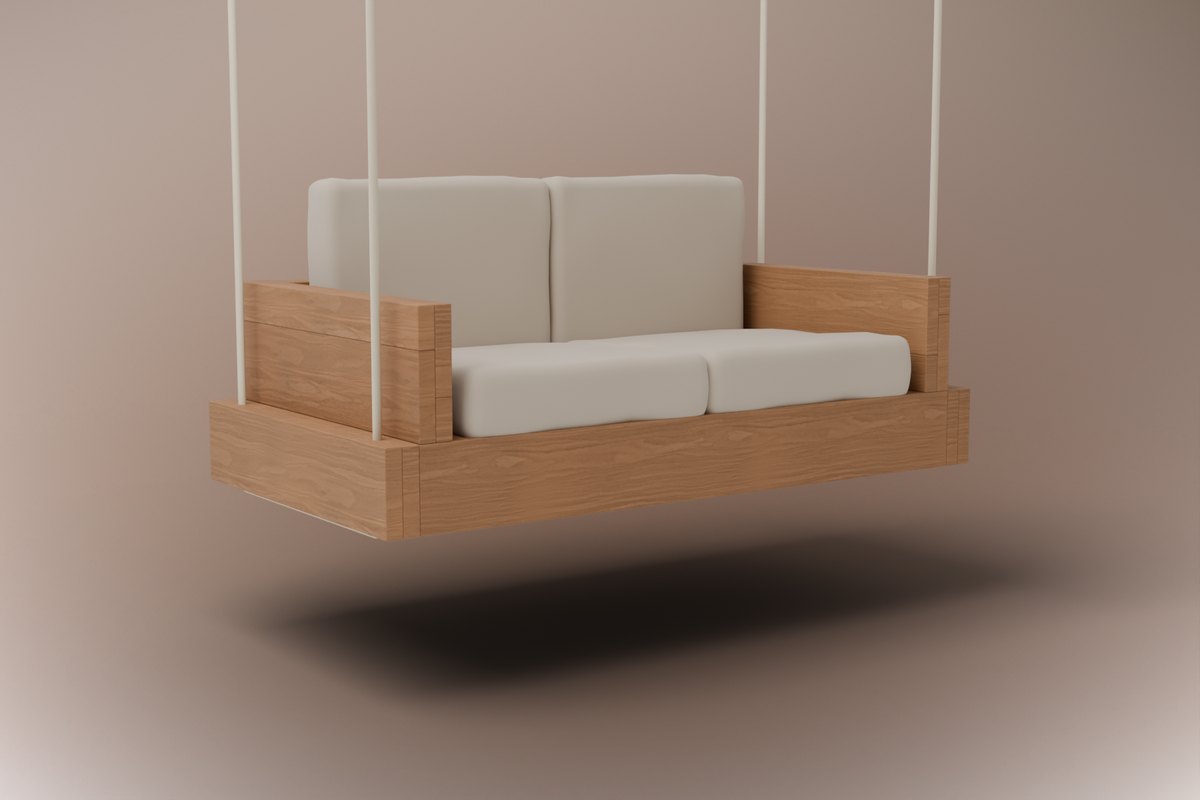
Drag to turn it. 3D model render, drawn from the plan itself; photos of the finished piece are coming soon.
Drift Loveseat Swing
A 63¼-inch loveseat swing built from 2x8s, 2x6s and 2x4s. The platform is a 7¼-inch-deep box with flush slats, the arms and back are low and square, and two ropes cradle it: each one runs down through a hole at the front, under the side and up through a hole at the back. It takes two standard 24-inch deep-seat cushion sets. Four cut lengths, 14 boards, every cut square, and every screw was checked in 3D to land in solid wood. The shopping list includes the rope and four hangers.
- Skill
- Level 2
- Build time
- About 7 hours
- Size
- 63¼" × 33½" × 18"W × D × H
- Lumber
- 14 boards, all 8 ft
Build-ready or your money back. If anything in the plan doesn't work as drawn, email us within 30 days for a full refund.
You buy the materials at Home Depot, not here. Cedar: from $750. Cushions extra, from $64.
- Printable plan and interactive 3D build guide
- One-trip Home Depot shopping list
- Yours to keep. Build it as many times as you like
31 parts, only 4 lengths.
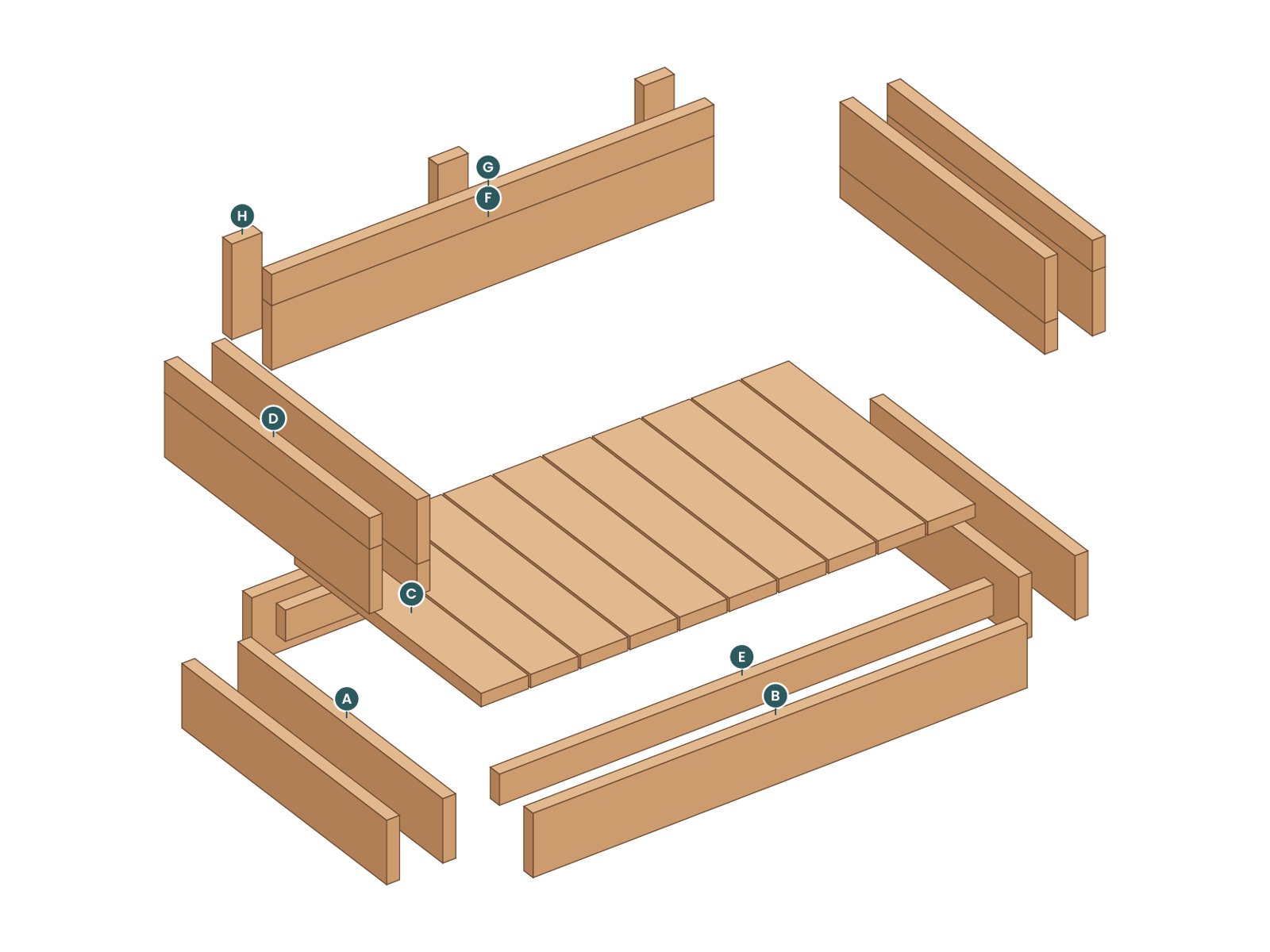
Every part gets a letter you pencil on its end. The drawings, the cut list, the cutting diagrams and the 3D guide all use the same letters, so you always know exactly which board you are holding.
- DrawingsFront, side and top views with dimensions
- Cut listEvery part by letter, board and length
- Cutting diagramsWhich part comes from which 8 ft board
- 9 stepsEach with time, check and common mistake
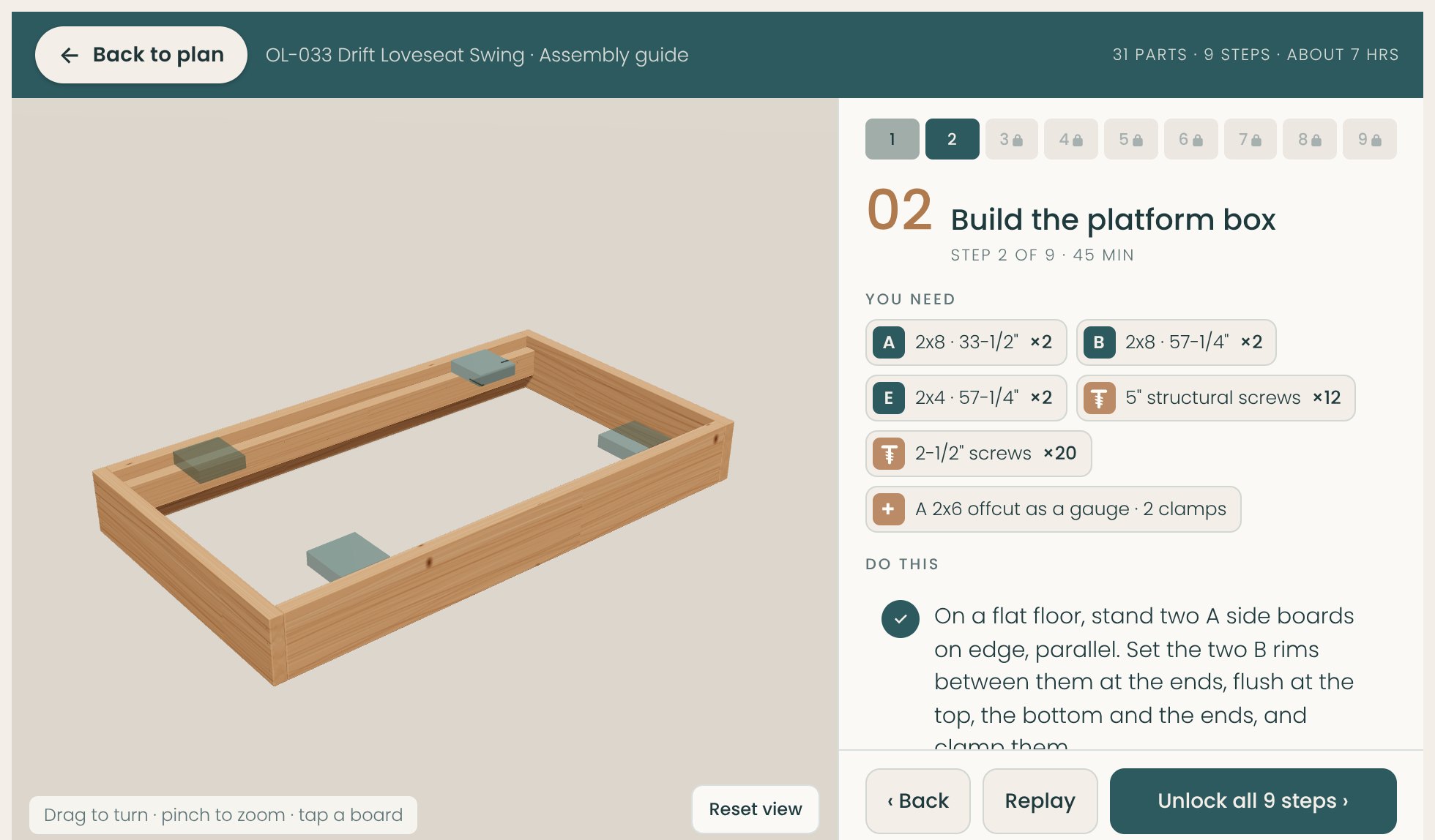
Try the build guide before you buy.
The first 2 of 9 steps are free. It’s exactly what you’ll follow in the garage, on your phone or laptop.
- Watch each step build itself, board by board, screw by screw.
- Spin and zoom the model with your finger or mouse.
- Tap any board to see its letter and cut size.
 Try steps 1–2 free
One list. One trip to Home Depot.
| Item | Qty |
|---|---|
| 2x8 × 8 ft pressure-treated pine, #2 Prime | 6 |
| 2x6 × 8 ft pressure-treated pine, #2 Prime | 4 |
| 2x4 × 8 ft pressure-treated pine, #2 Prime | 4 |
| 2-1/2" exterior wood screws, rated for treated lumber (hidden joints) | 62 (1 × 1 lb box) |
| 2-1/2" exterior trim-head screws, rated for treated lumber (seat slats) | 40 (1 × 1 lb box) |
| 5" structural wood screws (GRK RSS or SPAX) | 18 (1 × 25-pack) |
| 4" exterior structural screws (GRK RSS or SPAX), for the arms and back, from underneath | 20 (1 × 50-pack) |
| Heavy-duty swing hangers, rated 500 lb or more each, with lag screws (for a solid joist or beam) | 4 |
| 3/4" polyester rope, manila look (not natural manila: it rots outdoors). 50 ft covers an 8 ft ceiling; buy 100 ft above 9 ft | 1 × 50 ft coil |
| Behr semi-transparent stain & sealer, Cedar Naturaltone | 2 qt |
- Estimated build cost
- $370–$420
- BudgetHampton Bay CushionGuard 24 × 24 deep-seat setSeat and back, per seat$64
- PremiumGreendale Sunbrella 24 × 24 deep-seat setSeat and back, per seat$112
- Pick #2 Prime boards and sight down each one. Take the straightest and grab one spare of each size.
- Treated pine comes wet. Stack the boards flat with scrap spacers between them, out of the sun, for 2–3 weeks before you cut. Dry boards don't shrink or twist after you build.
- Use screws labeled for treated lumber (most coated exterior screws are) and galvanized brackets.
- Sand the faces and edges smooth, then stain once the wood is dry. A cedar-tone stain gives it the honey look in the photos.
- Wear a dust mask when cutting and sanding treated wood, and never burn the scraps.
Estimates based on typical Home Depot prices; your store may vary. Same cuts and same steps in either wood.
9 steps · about 7 hours
- 1Cut the partsFree in 3D1 hr
- 2Build the platform boxFree in 3D45 min
- 3Double the sides and drill the rope holes45 min
- 4Lay the slats40 min
- 5Build the two arms40 min
- 6Build the back30 min
- 7Fit the arms and back1 hr
- 8Sand and finish1 hr + drying
- 9Hang it1 hr 30 min
Good to know
How big is it?
63¼ inches wide, 33½ inches deep and 18 inches tall at the arms and back. The seat is 51¼ inches wide and 29 inches deep: two 24 × 24 deep-seat sets fill it.
How does it hang?
On two ropes, one per side. Each rope is tied to a front hanger, runs down through a 1-inch hole near the front of the doubled side, along under it, and up through a hole near the back to the back hanger. The swing sits in the ropes like a cradle. The four hangers go 60¼ inches apart side to side and 25½ inches front to back. It hangs about 8 inches off the floor, so the seat is about 20 inches high with the cushion.
What does my ceiling need?
Solid framing right above the hangers: ceiling joists at least 2x6, or a beam. Each hanger's lag screw has to go into the middle of a joist, never into a ceiling board, drywall or a fascia. Fully loaded, the swing puts about 700 lb on the ceiling. If the joists don't line up with the hangers, or you're not sure what's up there, ask a carpenter before you hang it. We can't check your ceiling for you.
How heavy is it?
About 120 lb in cedar. Wet pressure-treated pine is about twice as heavy as cedar, so dry the pine first or use KDAT. Every board is a one-person lift, but the finished swing is a two-person job: build it close to where it will hang.
Which cushions does it use?
Two standard 24 × 24 deep-seat sets, bought ready-made: about $64 a seat for Hampton Bay CushionGuard, or about $112 for Sunbrella.
Are there other sizes?
Drift Swing Chair (one seat), Drift Daybed Swing (a three-seat sofa or a twin mattress and both in one plan). Same look, same steps, sold as separate plans.
Which tools do I need?
A drill/driver with a 1-inch spade bit, a miter saw or circular saw, a tape measure, a speed square, two clamps, two sawhorses and a sanding block. To hang it you'll also want a stud finder, a ladder and a helper. Every joint is wood on wood with screws: no pocket holes, no glue-ups, no brackets.
Why polyester rope, not manila?
Natural manila rots and stretches outdoors. Polyester rope with a manila look keeps the same style, holds its length and stands up to sun and rain. Check the knots after the first week and at the start of each season.
Can I build it in pine to save money?
Yes. The plan comes with a second shopping list in pressure-treated pine, with the same cuts and the same steps. Pine needs a couple of weeks to dry and a coat of cedar-tone stain, but costs about a third as much as cedar.